
Thursday 12 Mar 2026
We’re not going to stand for it”, says TfL’s Commissioner, as TfL and Mayor of London convene urgent summit to tackle violence and aggression against transport staff
PN - 164
- The Mayor and TfL hold urgent summit on work-related violence and aggression, reaffirming commitment to protecting colleagues across the transport network
- TfL’s 2026 Work‑related Violence and Aggression (WVA) summit provides an important opportunity to hear directly from frontline workers and Unions about their lived experiences
- A new five-year strategy will be developed, driving meaningful, lasting action to improve staff safety on the network
- Transport staff work hard to serve the millions of customers who use the transport network every day and have the right to go about their work without fear or intimidation
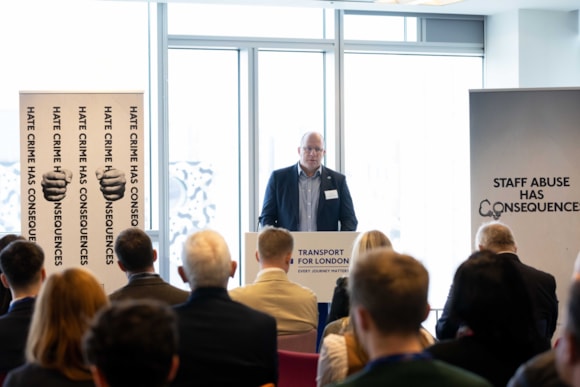
The Mayor and Transport for London (TfL) have today brought together senior transport leaders, frontline colleagues, the police and trade union representatives for its 2026 Work‑related Violence and Aggression (WVA) Summit. The Mayor and TfL have convened this urgent summit to reinforce its dedication to reducing violence, abuse and intimidation against transport staff, including its operators and contractors.
Delivering the keynote speech, the Mayor said that “no-one should have to clock in and then brace for abuse”, adding that, “we can, and will, solve it together”. London's Transport Commissioner Andy Lord also addressed the summit to say very clearly and unequivocally that TfL ‘won't stand for’ any form of workplace violence and aggression and will be doing everything possible to protect everyone's right to go to work without fear or intimidation.
The summit provides an important opportunity to reflect on the progress made under TfL’s first Pan‑TfL Work‑related Violence and Aggression Strategy, launched in 2020, and to shape priorities for the next five‑year strategy. By sharing insight, and best practice from across the organisation and beyond, TfL aims to strengthen its collaborative approach to reducing work‑related violence and aggression and ensuring the network remains safe, reliable and efficient for colleagues and customers. Working with transport police, TfL will always seek to bring offenders to justice using all available evidence such as body worn video, CCTV and journey information.
Every incident of workplace violence and aggression is completely unacceptable, and TfL is determined to tackle the abuse faced by staff. While overall WVA incident numbers have remained broadly stable over the past three years – with around 10,500 incidents in 2023/24 and an expected 10,800 in 2025/26 – this level of harm is simply far too high and shows that further action is urgently required. TfL has made important progress in reducing the most harmful forms of violence, with physical assaults against directly employed colleagues falling by 12.6 per cent from 957 incidents in 2023/24 to 836 in 2024/25. Overall so far this year, WVA incidents reported by TfL employed staff have fallen by 23 per cent - up to this point in 2023/24 there were 4,333 WVA incidents reported by TfL directly employed staff. At the same stage in this financial year (2025/26) there have been 3,317. However, there has been an unacceptable 28 per cent increase in incidents of WVA on bus drivers and rail operating staff so far this year compared to 23/24. Up to this point in 2023/24, there were 4,576 incidents of WVA reported by staff working on the buses and rail modes. At the same stage this financial year (2025/26) there has been 5,856. These trends underline the urgent need for continued and strengthened action across the network.
Despite TfL’s zero‑tolerance stance on WVA and significant investment in protective measures - including making body‑worn video essential kit for all frontline staff, CCTV improvements, enhanced policing, communications campaigns and interventions to reduce triggers of conflict- transport workers are still subjected to unacceptable levels of abuse, threats and intimidation. Rising hostility, antisocial behaviour and hate crime across society remain key concerns, as the proportion of incidents involving an element of hate rose from seven per cent in December 2024 to 13 per cent in December 2025. TfL recognises much more needs to be done to keep its staff and those working for its operators and contractors, safe across the network.
Fare evasion, ticket disputes and antisocial behaviour continue to be the leading triggers for abuse. TfL is committed to tackling this, and continues to penalise and prosecute thousands of fare evaders every year. TfL has more than 500 officers who undertake revenue activity on a daily basis across the network, issuing more than 52,000 penalty fares and reporting more than 15,000 passengers for possible prosecution this financial year. TfL’s data-driven strategy to tackle fare evasion is already making an impact, with the pan-TfL fare evasion rate dropping to 3.5 per cent from 3.8 per cent in 2023/24.
TfL recognises that the presence of police and uniformed enforcement staff provides a visible deterrent to crime and antisocial behaviour and provides reassurance and support to its customers, operational and customer-facing staff. TfL continues to work closely with the Metropolitan Police Service and British Transport Police to bolster enforcement, while its own 300‑strong Transport Support and Enforcement (TSE) team is also trained to address antisocial behaviour, manage conflict and enforce byelaws. Additional night‑time TSE teams launched in 2024 have expanded enforcement at key times, and TfL continues to expand its TSE team, with 100 more officers being recruited this year.
London’s Transport Commissioner, Andy Lord, said: “Every member of our workforce deserves to feel safe, respected and supported as they carry out the essential job of keeping London moving. While we’ve made real progress in reducing the most harmful forms of violence and aggression, the rising levels of hostility and hate across society make clear that we cannot be complacent. Today’s summit is about strengthening our shared determination, across TfL, our Trade Unions and the police, to build on the improvements we have achieved and to focus relentlessly on safety and protection for our people."
The Mayor of London, Sadiq Khan, said: “Violence and aggression towards anyone at work is completely unacceptable, and we must have zero tolerance for this on London’s transport network. Everyone has the right to work without fear of being assaulted, abused or threatened, and I’m determined to stamp out these harmful and traumatic incidents. Today’s summit reaffirms our commitment to eliminating work-related violence and aggression, while setting out further decisive action to protect all those who do vital work every day to keep the capital moving, as we continue building a safer London for everyone.”
BTP Deputy Chief Constable Stuart Cundy said: “Nobody should be subjected to violence or abuse on the railway network, especially staff who are simply doing their job. Just one report of an offence against rail workers is one too many. Today's summit reaffirms our commitment alongside TfL to ensuring those who serve passengers feel safe when doing so.
“Our teams of uniformed and plain clothes officers are out on the London railway day in and day out to protect everyone on the network and deter offending. Anyone who witnesses or experiences violence and intimidation on the railway is urged to report it to us by texting 61016. We take every report seriously and will act immediately to trace and arrest offenders.”
Contact Information
TfL Press Office
Transport for London
0343 222 4141
pressoffice@tfl.gov.uk
Notes to editors
- TfL has strengthened prevention measures across the network, with more than 3,500 customer‑facing colleagues completing enhanced conflict‑management training introduced in 2024. Body Worn Video has been mandatory for all frontline staff since January 2024, with more than 8,000 colleagues now equipped and over 6,000 devices available at 300 locations
- TfL's abuse has consequences campaign runs across the network and uses real life incidents of staff abuse to send a clear message to perpetrators that they will be caught, and action will be taken
- TfL’s fare evasion strategy can be found here: https://tfl.gov.uk/corporate/safety-and-security/security-on-the-network/tackling-fare-evasion#on-this-page-0


Powered by Onclusive PR Manager © 2026