
Tuesday 2 Jun 2026
TfL unveils next-generation Bus Safety Standard to make London buses safer than ever
PN-191
- The second phase of the Bus Safety Standard sets out new long-term safety requirements for buses entering service up to 2033
- New measures include major design improvements and cutting-edge technology to protect customers, drivers and other road users
- The first phase has already influenced national and international regulations, with innovations pioneered in London now used across the UK and abroad
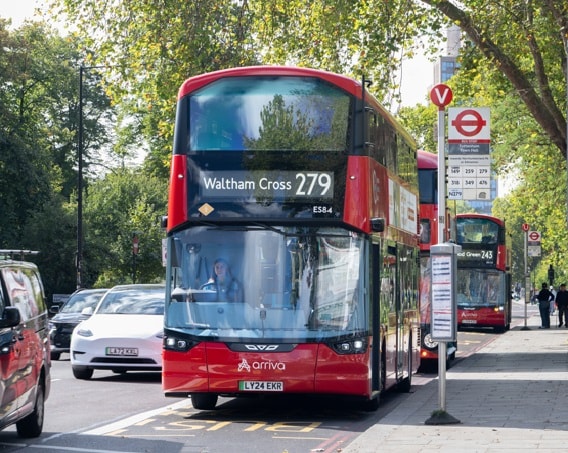
The future of London’s buses has been revealed, as Transport for London (TfL) publishes the next phase of its world-leading Bus Safety Standard. This sets out the next steps of safety requirements for buses entering service up to 2033 to ensure London continues to have one of the safest bus networks in the world.
Building on the progress to date, the second phase has been developed through extensive research, trials and close collaboration with manufacturers, operators, unions and safety specialists. It focuses on the collision types and injury risks that cause the greatest harm, while providing long-term certainty to support industry investment and innovation.
Key measures set out in the plan include:
Improving customer safety through better bus design
- Enhancements to vehicle interiors that will reduce slips, trips and falls - one of the leading causes of injury. Measures include improved lighting, clearer safety messaging and the introduction of tip seats (a seat that automatically folds upright when not in use), which will be required from 2030.
- Accessibility improvements include better communication between wheelchair users and drivers, including enhanced audio for ramp deployment.
New technology to support safer driving
- A new 'Moving-Off Information System', which will intervene to prevent the bus from moving off if a pedestrian or cyclist is immediately in front of the bus.
- Enhancements to the Advanced Emergency Braking system will extend protection to turning scenarios, alongside new acceleration suppression technology to help stop drivers accidentally pressing too hard on the accelerator pedal.
Stronger measures to tackle driver fatigue and distraction
- Building on trials across 400 buses, new systems will provide visual, audio and touch alerts when fatigue or distraction is detected. TfL will go beyond national regulations by activating alert systems from 5kph (instead of 20kph), alongside improved monitoring and reporting to support driver wellbeing.
Reimagined driver cab to support safety and wellbeing
- A redesigned, ergonomic cab will improve comfort, inclusivity and security for drivers - supporting safer driving. This includes immediate design improvements and longer-term research to inform future standards.
TfL takes bus drivers’ safety and welfare seriously and contracts rightly require operators to meet high standards. Bus drivers play an essential role in keeping the capital moving and TfL continues to work on a range of measures to improve working conditions, health and wellbeing.
Buses remain the safest way for people to travel on London’s roads and carry more passengers than any other public transport mode, recently released TfL road casualty data shows. In 2025, 10 people were tragically killed in collisions involving a bus and, although no death is acceptable on London’s roads, this is the lowest number since 2021. [1] Bus passenger injuries are also the lowest on record, except in 2020 during the pandemic.
Since its launch in 2018, many measures in the first phase of the Bus Safety Standard have become standard features of new vehicles beyond London, including Manchester and Northern Ireland, with Hong Kong and Singapore also adopting these measures. Casualty numbers on the Bus Safety Standard routes fell by approximately 41 per cent over the period analysed, compared with a reduction of around 22 per cent on control routes, highlighting the positive effects of integrating multiple safety systems into a single vehicle standard.
The Bus Safety Standard is central to TfL’s work to improve safety for all road users and to achieve its Vision Zero targets for no one to be killed on, or by, a bus by 2030, and to eliminate all deaths and serious injuries from the transport network by 2041. TfL has made considerable progress towards its Vision Zero goals with a 28 per cent reduction in the number of people killed or seriously injured in collisions involving a bus and a 40 per cent reduction in the number of customers or bus drivers killed or seriously injured on a London bus from the 2010-2014 baseline.
Sadiq Khan, Mayor of London, said: "London’s bus network is one of the safest in the world, and I’m proud that we are making real progress in eliminating death and serious injury from the network. But we must go further and faster to eliminate this heartbreak across the capital.
"This new world-leading safety standard is an important part of our work towards achieving Vision Zero across the bus network. It will help protect passengers, the bus drivers who keep London moving, as well as other road users, while supporting innovation that can prevent collisions and save lives.
"I’d like to thank partners, manufacturers and operators for their help in developing this standard, which is vital to building a safer, fairer, better London for everyone."
Lorna Murphy, TfL's Director of Buses, said: "We continue to put safety at the heart of everything we do on London's bus network and are determined to meet our Vision Zero goal of eliminating death and serious injury across all forms of transport.
"The launch of the second phase of the Bus Safety Standard demonstrates the strength of our collaborative approach, working closely with operators, manufacturers and partners to improve safety across every aspect of the bus and deliver a safer network for everyone - including customers on and off the bus and our hard-working drivers. We know there is more to do, and we will not stop until we achieve our Vision Zero goal."
Contact Information
TfL Press Office
Transport for London
0343 222 4141
pressoffice@tfl.gov.uk
Notes to editors
- TfL's Bus Safety Standard can be found - https://content.tfl.gov.uk/bus-safety-standard-2.pdf
- [1] Road fatalities in London since 2019 – TfL Road Safety Data webpage
- All provisional 2025 road casualty data can be found on TfL's road danger reduction dashboard here: Road Danger Reduction PowerBI dashboard
Downloads

Powered by Onclusive PR Manager © 2026