
Tuesday 3 Mar 2026
TfL selects SSE Energy Solutions to deliver solar power directly to help run the Tube
PN - 159
- Collaboration could deliver up to 65,000 megawatt hours of renewable electricity, which is the equivalent of around two-thirds of the estimated annual consumption of the Victoria line
- New solar installations feeding TfL’s private electricity supply will reduce pressure on Great Britain’s National Grid and help stimulate green jobs
- As London’s largest single electricity consumer, TfL is at the forefront of the green transition, with a bold ambition to use 100 per cent renewably sourced electricity across TfL's operations by 2030
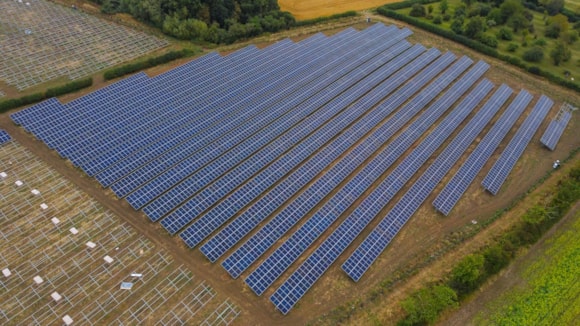
The sun will soon be powering significant parts of London’s underground network after Transport for London (TfL) appointed SSE Energy Solutions as its delivery partner to build purpose-built solar installations to connect to the Tube network. The move, which followed a competitive procurement process, means that TfL will receive zero-carbon electricity straight from the solar installations themselves, bypassing the National Grid. As London’s largest single electricity consumer, TfL is at the forefront of the green transition – with this one of the first private wire schemes for an urban transport network and part of TfL’s ambition to use 100 per cent renewably sourced electricity across TfL's operations by 2030.
Now that SSE Energy Solutions has been selected as TfL’s delivery partner, it will work with TfL to identify suitable locations to build the new solar installations. These will likely be required to be close to the TfL network to enable the direct connection and could incorporate a mixture of solar opportunities, including both ground mounted solar installations or rooftop panels. Once constructed, they could deliver up to 65,000 megawatt hours (MWh) of renewable electricity to the network, which is the equivalent of around two-thirds of the estimated annual consumption of the Victoria line* or the electricity consumed each year by around 25,000 homes**. There is the potential to save more than 27,000 tonnes of carbon in total over 25 years – the equivalent of almost 32,900 flights between London and New York City - while also stimulating the market for green jobs***.
TfL is the largest single electricity consumer in London with a demand of approximately 1.6 Terawatt hours (TWh) per year, which is equivalent to the electricity consumed by around 592,600 homes** or 15.5 per cent of homes across London****. The appointment of SSE Energy Solutions as TfL’s delivery partner will enable TfL to directly receive zero-carbon electricity from local solar installations that will be purpose-built, bypassing the National Grid's centralised sources and Distribution Network Operators and thereby reducing pressure on central electricity grids. The collaboration also guarantees generated renewable power to TfL at a fixed price, protecting TfL against market volatility, while also contributing to the country’s security of supply as it is locally generated. In the longer term, this private wire scheme could potentially generate additional financial savings through bypassing some of the costs associated with delivery of power through the National Grid.
This latest agreement forms a key part of TfL's long-term Energy Purchasing Strategy, which will see it purchase up to 70 per cent of the total electricity it needs through Power Purchase Agreements (PPAs). Last summer, following a competitive procurement process, TfL confirmed that it had appointed a delivery partner to generate and deliver green electricity via a PPA – TfL’s first such agreement. The contract will see a new solar facility built in Longfield, Essex, and renewable energy generated for the Tube. This will support the decarbonisation of the national grid, while providing TfL with renewable energy at a fixed price. The remainder of TfL’s electricity will mainly be procured through a flexible green tariff, contributing to the wider ambition to use 100 per cent renewable source electricity across TfL's operations by 2030, and support the Mayor's goal for London to be a net zero carbon city by 2030.
Deputy Mayor of Environment and Energy, Mete Coban, said: “I am delighted that TfL is taking this major step towards powering London’s transport system with clean, green energy – bringing us closer to our goal of operating on 100 per cent renewable electricity by 2030. As these new sites are selected, they will create green jobs, boost biodiversity, and supply clean power, relieving pressure on the National Grid as we continue to build a fairer, greener London for everyone.”
Lilli Matson, Chief Safety, Health and Environment Officer at TfL, said: “We’re excited to be working together with SSE Energy Solutions to deliver renewable electricity directly to the Tube network. Once built, the new solar installations will provide locally generated renewable electricity, reducing the pressure on the National Grid, while also helping to protect us against market volatility with the added potential for cost savings too.
“We all need to play our part to support the successful transition to renewable energy, working together across the public and private sectors. As one of the largest electricity consumers in the UK, we’re committed to being the strong, green heartbeat for London. This collaboration is just one of the ways that we’re working towards our wider ambition to use 100 per cent renewable source electricity across our operations by 2030.”
Nathan Sanders, Managing Director of Distributed Energy, SSE Energy Solutions, said: "SSE Energy Solutions is proud to be appointed by TfL to deliver renewable energy directly to the Tube via private-wire - supporting London’s 2030 net zero ambition and TfL's Corporate Environment Plan. We'll invest in, build, operate and maintain the projects, helping to decarbonise and manage price volatility while enabling potential savings for TfL.”
As part of a significant and radical programme of work to reduce carbon emissions across London, TfL is working to remove fossil fuels across its buildings and is also investing in further decarbonising its operations, including transitioning its support vehicles and buses. It continues to work towards a fully zero-emission bus fleet, which is acting as a catalyst for new production models and is helping to transform the bus industry in the UK. Already, more than 2,800 buses are now zero-emission models, representing the largest such fleet in Western Europe.
TfL is also converting lighting within stations, bus shelters and on trains to LEDs, which use up to 60 per cent less energy than traditional lighting, while achieving around a 10 per cent increase in brightness. Currently, more than 40 per cent of Tube stations across London have been converted to LED lighting, and TfL expects to have all bus shelters, including those used in advertising panels, converted to LEDs in the coming months.
For construction projects, TfL is taking an active approach to decarbonisation by recently signing up to the Construction Leadership Council's Five Client Carbon Commitments. This involves setting out actions under a common framework on how to reduce carbon emissions from its construction activities.
TfL is already making progress to include low carbon requirements in its contracts, reducing carbon in major construction projects like Old Street, Neasden and Surrey Quays. TfL also continues to improve processes in early stages of construction and taking a structured, phased approach to decarbonisation, including reducing the 25 per cent of embodied carbon emissions from steel and 20 per cent of the same from concrete materials on site and work towards emission-free deliveries by 2030 and diesel-free sites by 2035.
The TfL Corporate Environment Plan, launched in 2021, explains how TfL will help make London a net zero carbon city by 2030 and achieve the environmental outcomes of the Mayor's Transport Strategy. TfL is delivering measures to clean London's toxic air such as the London-wide Ultra Low Emission Zone, the growing numbers of greener buses and zero emission capable taxis.
Contact Information
TfL Press Office
Transport for London
0343 222 4141
pressoffice@tfl.gov.uk
Notes to editors
Additional Information
- * The approximate annual consumption of the Victoria line has been modelled and estimated, using historic traction modelling data
- ** Source: Based on the average power per household taken from Ofgem https://www.ofgem.gov.uk/information-consumers/energy-advice-households/average-gas-and-electricity-use-explained
- *** Based on Air travel conversion factors taken from Department of Energy Security and Net Zero (DESNZ) https://www.gov.uk/government/publications/greenhouse-gas-reporting-conversion-factors-2025
- **** Source: Ministry of Housing, Communities and Local Government, Live tables on dwelling stock (including vacants), Table: Live tables on dwelling stock (including vacants) - GOV.UK100 [Accessed February 2026] [Some authorities providing this data have indicated that the data reported for ‘other public sector’ stock may be based on partial information]
- SSE Energy Solutions will build, operate and maintain the solar installations as part of this framework, with no capital costs or operational overheads for TfL. TfL would pay for the electricity generated to power the transport network
- The framework is in place for four years, with the opportunity to extend for a further four years
- While the focus of the contract is to bring forward purpose-built solar installations to connect to the London Underground network, there may also be potential opportunities to connect to other parts of the TfL estate too, such as depots.
- As London's largest single consumer of electricity, electricity directly procured by TfL from the GB electricity grid currently totals 41 per cent of our operational carbon emissions (321,000 tonnes CO2e), and for the financial year 2024/2025 this had a cost of approximately £350m. Total TfL operational emissions currently stand at 786,000 tonnes CO2e

Powered by Onclusive PR Manager © 2026